
Why Most Strategies Fail at Execution (And How to Fix It)
Why Your Best Ideas Keep Dying After the Kickoff Meeting
Most strategies don't fail because the idea was wrong. They fail in the space between the plan and what actually happens next.
Think about the last big initiative your team rolled out with real energy behind it. The deck looked sharp. Leadership was excited. Everyone nodded along in the room.
Now think about where that initiative actually landed six months later.
If there's a gap between those two moments, you're far from alone. Somewhere close to 90% of corporate strategies fail, and it's almost never the idea itself that's the problem. It's everything that was supposed to happen after the idea got approved.
That gap is where most organizations quietly lose momentum, budget, and trust. It's also where Kevin Ertell has spent the last three decades working.
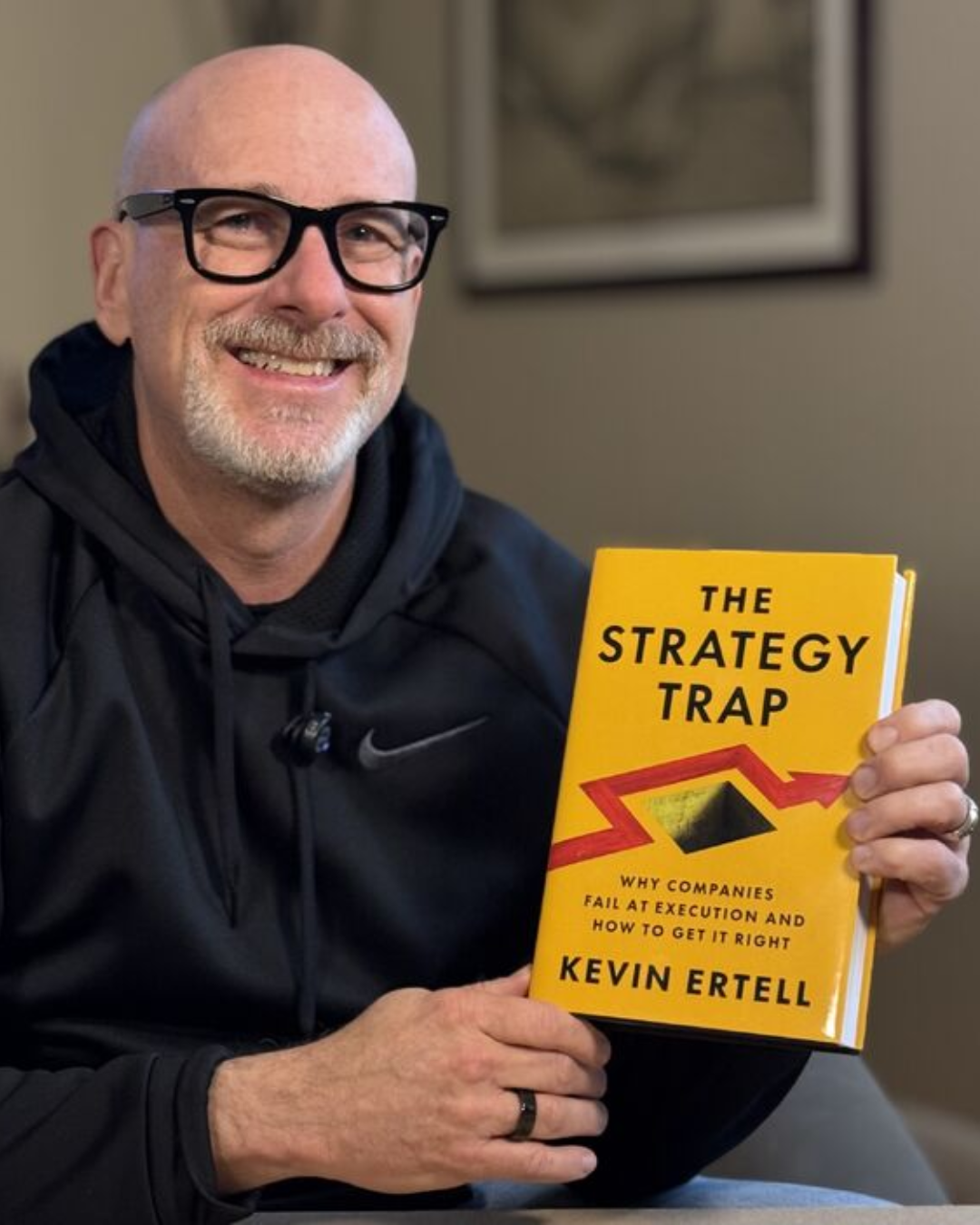
(00:00) Thirty Years of Watching Good Ideas Stall
Kevin Ertell has spent more than three decades leading transformations at brands most people would recognize immediately: Nike, Tower Records, Sur La Table.
Across every industry and every size of company, he kept running into the same pattern. The strategy wasn't usually the problem. What happened to it after the meeting ended almost always was.
That pattern eventually became the foundation his new book, The Strategy Trap: Why Companies Fail at Execution and How to Get It Right.
Rather than write it from a single point of view, Kevin interviewed more than 60 operators across industries and company sizes, chasing what he calls a thousand years of combined experience on the subject.
When he's not consulting, he's playing bass, cooking for his family, or watching Cleveland sports with a level of optimism most fans would call stubborn.
(06:30) The Habit That Feels Wrong Until It Works
Every driven leader has the same instinct once a strategy gets approved: move fast.
Kevin's research says that instinct is usually the thing that sinks it.
His advice runs against the grain: slow down to speed up. Not stalling. The setup work that determines whether a launch survives contact with reality. Skip it, and the crash still happens, just later, and at a much higher cost.
A race car doesn't accelerate into a curve. It slows down first, so it can come out faster on the other side. It's the comparison Kevin uses to explain the whole idea.
A team that isn't prepped before a rollout doesn't move faster by skipping prep. It just fails somewhere more expensive.
The organizations getting real results, in Kevin's experience, aren't the fastest starters. They're the most deliberate ones.
(18:40) Six Letters, One Entire System
Execution breaks down into two distinct phases, and each one runs on three principles Kevin calls the six C's.
Before anything launches:
Co-creation — build the plan with people, not for them
Clarity — strip the message down until it can survive being repeated a hundred times by a hundred different people
Capacity — make space for the work before asking anyone to do it
Once it's live:
Communication — early, loud, and constant, never a one-time announcement
Coordination — clear ownership, with everyone knowing exactly where handoffs happen
Coaching — the daily, active leadership that adjusts when reality doesn't match the plan
Kevin doesn't present this as a straight line. He calls it a system leaders move through and circle back to, not a box to check once.
(25:10) The Trap Hiding in Plain Sight
Here's where Kevin says most organizations quietly go wrong, long before anyone notices:
A small group of leaders builds the strategy behind closed doors. It feels efficient. Decisions move fast, nobody outside the room slows things down.
Kevin calls this the isolation trap, and he's watched it sink plans at every size of company he's worked with.
Then there's what he calls the complexity trap: business jargon that sounds sharp in a boardroom but lands as static everywhere else in the organization. The people closest to the work, the ones who'd catch the gaps early, never got a seat at the table to catch them.
(33:20) Empathy Is Out. Here's What's Replacing It.
A lot of leadership advice tells you to lead with empathy. Kevin would push you toward something else.
"I don't think strategy and execution are two different things," he says. "Writing the strategy is the early part of execution."
It's a reframe Kevin comes back to throughout his book, and it changes how a leader shows up to every decision after the plan is written.
In Kevin's view, empathy tells you how someone feels about a change. Curiosity asks why, and what they're actually experiencing on the other end of it.
So Where Does This Actually Start?
Not with a better strategy document. Almost every organization already has one of those.
Kevin's answer starts with getting honest about where jargon, isolation, and speed have quietly replaced the setup work that actually makes execution stick.
He goes deeper into how his concept of validation works in practice, what separated the operators who execute from the ones who stall across his 60-plus interviews, and why he thinks curiosity might be the most underrated leadership skill nobody's training for.
Connect with Kevin Ertell: The Strategy Trap: Why Companies Fail at Execution and How to Get It Right | LinkedIn | Mistere Advisory
Connect with Traci here: https://linktr.ee/HRTraci